Comparative Evaluation of an Allergen Exposure Chamber and Nasal Allergen Challenge Versus In-Field Symptom Assessment in Patients With Allergic Rhinitis Triggered by Timothy Grass Pollen
Magdalena Zemelka-Wiacek, Anna Kosowska, Oliver Pfaar, Ioana Agache, Krzysztof Kujawa, Marek Jutel
Share post:
Abstract
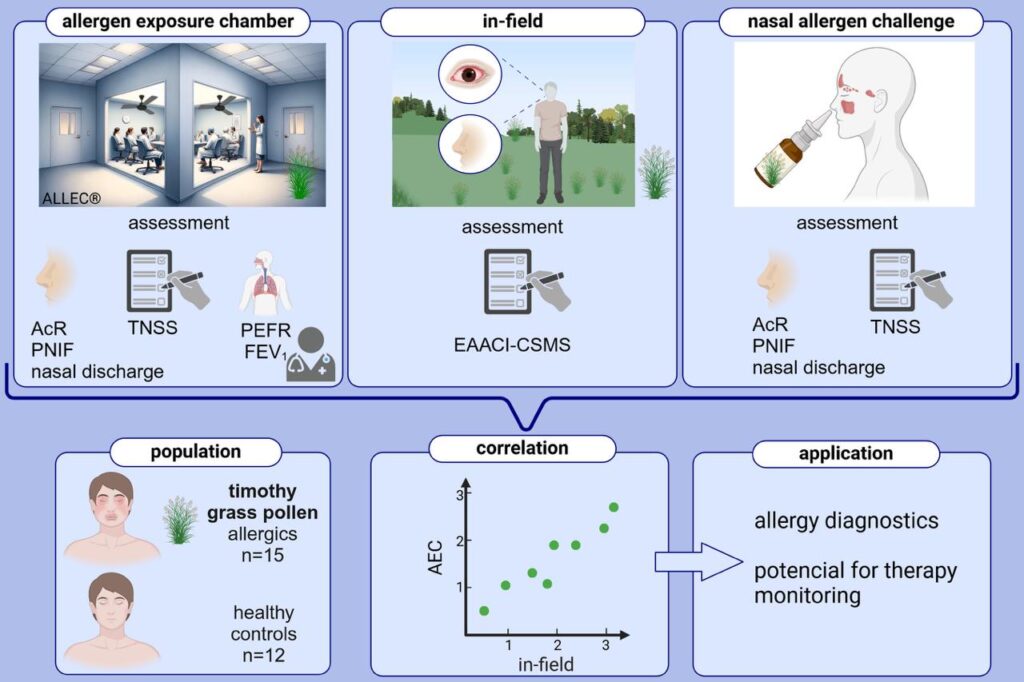
Background: An allergen exposure chamber (AEC) is a specialized medical facility designed to expose individuals to allergens at precise and consistent concentrations within a controlled environment. This study aimed to correlate the assessment of clinical endpoints in patients with allergic rhinitis sensitized to timothy grass pollen (Phleum pratense) by comparing three different methods: AEC, nasal allergen challenge (NAC), and symptoms during natural exposure during the grass pollen season.
Methods: Fifteen allergic subjects and twelve healthy controls were evaluated in the ALLEC AEC; allergic symptoms were measured by subjective and objective methods, including total nasal symptom score (TNSS), acoustic rhinometry (AcR), peak nasal inspiratory flow (PNIF), and nasal discharge amount. For the in-field evaluation, a combined symptom medication score (EAACI-CSMS), as proposed by the European Academy of Allergy and Clinical Immunology (EAACI), was used, which was assessed for 14 days during the peak of the pollen season. The AcR, PNIF, and TNSS were used for the NAC assessment.
Results: Both in the AEC and NAC, all allergic individuals developed symptoms at the optimal pollen/allergen concentration across all the measured endpoints. Using Spearman’s rank correlation coefficient (p < 0.05), the analysis revealed significant correlations between symptoms assessed in AEC at 120 min of the challenge, as well as in NAC after 15 min with the EAACI-CSMS in-field. The correlations between in-field assessment and AEC were stronger than those with NAC, which showed weaker or no significant correlations. This indicates that the AEC challenge correlates better with in-field assessments than NAC.
Conclusion: Clinical endpoints assessed to allergen exposure in the AEC and NAC significantly correspond to the efficacy analysis in-field (EAACI-CSMS during the peak of pollen exposure). The effect of NAC was not significant for all outcomes measured. Both methods might be considered to be an alternative to traditional assessment during natural exposure.
Zemelka-Wiacek M, Kosowska A, Pfaar O, Agache I, Kujawa K, Jutel M. Comparative Evaluation of an Allergen Exposure Chamber and Nasal Allergen Challenge Versus In-Field Symptom Assessment in Patients With Allergic Rhinitis Triggered by Timothy Grass Pollen. Allergy. 2025 May;80(5):1286-1297. doi: 10.1111/all.16518. Epub 2025 Mar 9. PMID: 40059339; PMCID: PMC12105075.